My mother-in-law thinks this tool sharpens her knife, but I didn’t think so. We can’t seem to agree. Is she right?
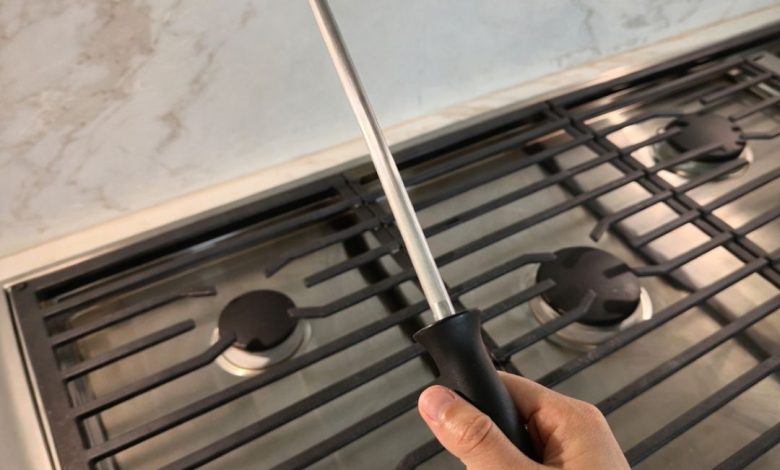
Keeping kitchen knives in top condition is one of the most important parts of cooking well. A sharp knife gives you better control, cleaner cuts, and safer food prep. Yet many people still confuse two common knife-care tools: the honing rod and the sharpening tool. Because they are often used in similar situations, it is easy to assume they do the same job. They do not.
If you have ever had a disagreement in the kitchen about whether a honing rod actually sharpens a knife, the answer is simple: a honing rod does not truly sharpen a dull knife. What it does is different, and understanding that difference can completely change the way you care for your knives.
What a Honing Rod Really Does
A honing rod is designed to realign the knife’s edge, not rebuild it. With everyday use, the very thin cutting edge of a knife can start to bend slightly to one side or become uneven. Even if the blade has not gone fully dull, that tiny misalignment can make the knife feel less effective.
Using a honing rod helps straighten that edge back into position. This is why a knife may seem sharper after honing. In reality, you are restoring the edge’s alignment, not creating a brand-new cutting surface.
That is why honing is best viewed as routine maintenance. It helps a knife perform better between sharpenings and can extend the amount of time before more serious edge work is needed.
Why Honing Is Not the Same as Sharpening
True sharpening works differently. Sharpening involves removing a small amount of metal from the blade to form a new, sharper edge. This can be done with a whetstone, a manual sharpener, or an electric sharpening system.
When a knife has become truly dull, honing will not be enough. At that point, the blade needs fresh edge geometry, and only sharpening can provide it. In other words, honing maintains an edge, while sharpening creates one.
This distinction matters because many people keep using a honing rod on a dull knife, expecting it to come back to life. If the edge is already worn down, no amount of honing will restore real sharpness.
The Biggest Misunderstanding in Knife Care
One of the most common myths in home kitchens is the belief that running a knife over a steel rod automatically sharpens it. That belief persists because the knife often feels a little better afterward. But that improved performance usually comes from straightening the edge, not grinding a new one.
A good way to think about it is this: honing is maintenance, sharpening is repair.
If your knife still cuts, but not as smoothly as before, honing may help. If it struggles to slice a tomato, crushes herbs, or slips instead of biting into food, it likely needs sharpening.
Why Both Tools Matter
The truth is that honing rods and sharpening tools are not competitors. They are partners in proper knife care. A honing rod helps you keep a knife working well from day to day. A sharpening stone or other abrasive sharpener is what you use when the edge has actually worn down.
Using both correctly gives you the best results. Regular honing can reduce how often you need to sharpen, and proper sharpening restores the performance that honing alone cannot bring back.
How Often Should You Hone or Sharpen?
For people who cook often, honing can be done regularly, even before or after cooking sessions. Sharpening happens much less often and depends on how frequently the knife is used, the type of cutting surface, and the quality of the steel.
A home cook may need to sharpen only occasionally, but honing can become part of normal upkeep. The key is recognizing when the knife’s edge is simply out of line and when it is actually dull.
The Best Way to End the Debate
If there is confusion in your household about knife care, the simplest solution is to explain that both sides may be partly right. A honing rod does improve how a knife performs, but it does so by realigning the edge, not by removing metal and creating a new sharp edge. Sharpening, on the other hand, is what truly restores a dull knife.
Once you understand that difference, the debate becomes much easier to settle. A honing rod keeps a knife in shape. A sharpener brings it back when it has lost its edge. Both are useful, but they are not the same.
In the end, proper knife maintenance is not about choosing one tool over the other. It is about knowing what each tool is meant to do. And when you use them the right way, your knives stay safer, more efficient, and far more enjoyable to use in the kitchen.