What is this thing on the outside of a recreation center?
Some of the best clues on old buildings are not grand or beautiful. They are small, rusty, and easy to miss.
A sealed doorway. A lonely pipe. A square hole in a wall. A metal bracket with no obvious job anymore.
Most people pass by without thinking twice. But sometimes, those odd details are the building’s way of whispering, “I used to be something else.”
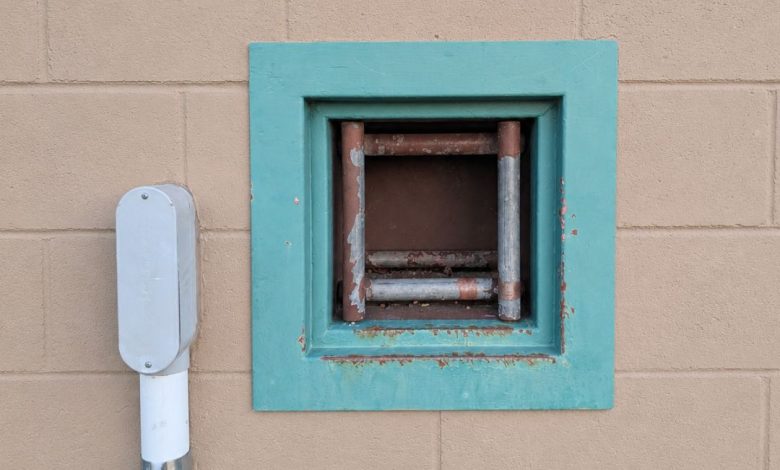
One strange example is a small square opening on the outside wall of an old recreation center. It measures roughly 12 inches by 12 inches, and inside the frame are four metal rollers. At first glance, it might look like a vent, a utility access point, or some forgotten service hatch.
But those rollers are the real clue.
This opening was most likely an old swimming pool lane divider pass-through.
Why Would a Pool Need This?
Pool lane dividers may look simple when they are floating in the water. To most swimmers, they are just long ropes covered with plastic floats.
But when those lane dividers are removed from the pool, they become a problem.
They are long, bulky, stiff, and awkward to move. Once wound onto a large reel, a lane divider can be difficult to carry through regular doors or narrow hallways, especially in older recreation centers built before modern storage designs became common.
That is where a roller-lined wall opening made sense.
The lane divider reel could be stored in a nearby room or service area. When staff needed the lane rope, they could pull it through the square opening and guide it toward the pool deck. The rollers helped the rope and plastic floats move smoothly without scraping against concrete, brick, or metal.
It was not fancy technology. It was just practical old-school building design.
The Rollers Tell the Story
The most important detail is that the metal pieces inside the opening are not fixed pipes. They spin.
That matters.
If the opening were only meant for air, drainage, or a stationary pipe, it would not need rollers. But if something heavy or awkward had to be pulled through again and again, rollers would make perfect sense.
They would reduce friction. They would protect the wall. They would keep the plastic floats from catching on sharp edges. And they would make the job easier for the pool staff who had to drag lane dividers in and out day after day.
You can almost hear the scene: the squeak of an old reel, the hollow clatter of plastic floats, the echo of voices inside a public pool building, and someone calling from the deck, “Keep pulling!”
A small metal frame like this was part of the hidden labor that kept community pools running.
A Reminder of Classic American Public Pools
For many Americans, old recreation centers bring back a very specific feeling.
Cinder block walls. Wet concrete floors. The smell of chlorine. Echoes bouncing off high ceilings. A lifeguard whistle cutting through the noise. Kids trying not to run while obviously speed-walking toward the deep end.
Lane dividers were always part of that world, but most people never thought about where they came from or how they were stored.
They just appeared when lap swim began, when swim lessons started, or when the pool had to be divided for teams and classes.
But behind the scenes, someone had to haul them out, untangle them, reel them back in, and store them somewhere. A lane divider pass-through was a simple tool for that everyday work.
What If There Is No Pool There Anymore?
If the recreation center still has a pool, the explanation is probably straightforward.
But if there is no pool nearby, the little square opening becomes more interesting.
It may be a leftover clue from a pool that was removed, filled in, closed, or replaced years ago. Old buildings often keep traces of their past long after their original purpose disappears. A drain hidden under new flooring. Old tile behind drywall. A sealed doorway that once led somewhere important. A strange roller frame still mounted on an outside wall.
In some cases, the history of public pools in the United States can also be complicated.
Many public pools were once segregated during the Jim Crow era. In some communities, pools were closed, abandoned, or filled in rather than integrated. That does not mean every missing pool has that story. Many pools closed because of maintenance costs, leaks, safety issues, budget cuts, or newer facilities being built elsewhere.
Still, when an old recreation center has strange pool-related clues, it is worth asking: Was there once a pool here? What happened to it? Who used it? Who was kept out?
Old aerial photos, city records, newspaper archives, parks department files, and longtime residents can sometimes answer those questions.
A Small Object With a Larger Memory
At first, this square frame with rollers may look like nothing more than a forgotten piece of metal.
But it may point to a whole lost routine: swim lessons, summer afternoons, lifeguards, lane ropes, storage rooms, wet towels, and generations of people using a public pool.
That is what makes old building details so fascinating.
History does not always come with a plaque or a museum label.
Sometimes it is just rusting quietly on the side of a recreation center, waiting for someone curious enough to stop and ask what it used to do.