Unravels and goes back – magnetic into itself but not onto the fridge.. front and back, sharpie for size. What is it?
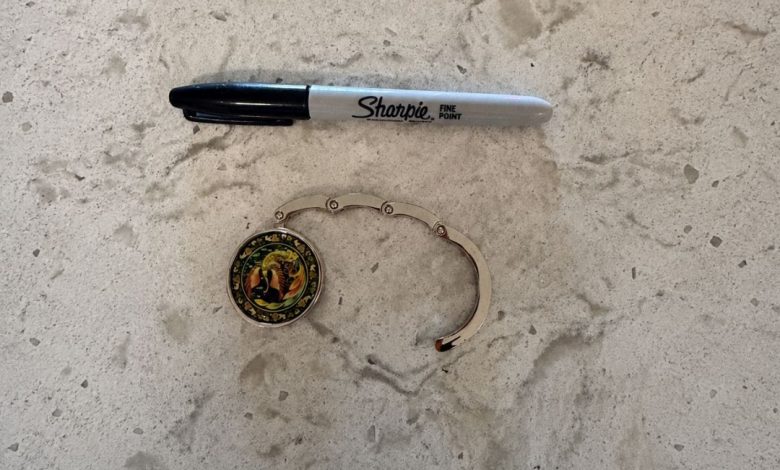
The small round object shown beside the Sharpie is a folding purse hook, also called a handbag hanger, table purse holder, or bag hook.
Although it may resemble a bracelet or a decorative compact when closed, it is designed to hang a handbag from the edge of a table or counter.
How It Works
The decorative round section is the base. The black circular material on the back is a nonslip pad, usually made from rubber or a similar material.
To use it:
- Unfold the curved metal arm.
- Place the black nonslip side flat on top of a table, close to the edge.
- Allow the metal arm to extend over and below the table.
- Hang a purse strap, shopping bag, umbrella, or other lightweight item from the lower end of the hook.
The weight of the bag pulls downward while the base remains on the tabletop. The nonslip backing provides friction and helps prevent the holder from sliding. Patent descriptions of these devices specifically identify a flat base, a friction-producing bottom surface and a hook that hangs below the table.

Why Is It Magnetic but Does Not Stick to a Refrigerator?
The magnet is most likely a closure mechanism, not a mounting magnet.
When the curved arm is folded around the circular base, the magnet attracts part of the metal mechanism and keeps the hook closed during storage. This prevents it from opening and catching on other objects inside a handbag.
The black nonslip pad may also separate the magnet from an outside surface and reduce its ability to attach firmly to a refrigerator. A patented portable purse hanger from the 2000s specifically describes a magnetic locking element that holds its linked arm in a closed ring-shaped position.
Therefore, the magnetic behavior described—snapping back into itself but not attaching securely to a refrigerator—is normal for this type of product.
When Was It Introduced?
The basic purse-hook concept has existed in various forms for many decades. Historical versions were already being produced by the early-to-mid 20th century, followed by rigid, pivoting and collapsible designs.
The compact folding style became especially developed during the 2000s. One influential portable purse-hanger design with a collapsible linked arm and magnetic closure had a priority date of August 15, 2006, was published in 2008 and later received a U.S. patent in 2010.
Another foldable handbag-hanger design, first filed in 2007, described a compact C-shaped hook, a nonslip table surface and a mechanism small enough to carry inside a handbag.
However, the photographs do not reveal the manufacturer or production date of this particular tiger-decorated example. Its exact age cannot be determined from its appearance alone.
What Was It Made For?
Its main purpose is to keep a handbag clean, visible and within easy reach in places where there is nowhere convenient to put it, including:
- Restaurants and cafés
- Bars and hotel counters
- Offices and meeting rooms
- Restrooms and dressing areas
- Airports and waiting rooms
It can also help keep a bag away from crowded walkways and make it more difficult for someone to take the bag unnoticed.
Final Identification
Object name: Folding purse hook or handbag hanger
Approximate category origin: Early 20th century
Modern folding magnetic version: Widely developed and patented during the 2000s
Primary use: Hanging a purse or small bag from a table
Magnet’s purpose: Holding the device closed—not attaching it to a refrigerator
The decorative tiger image turns an ordinary utility item into something resembling a piece of jewelry, allowing it to be carried discreetly inside or attached to a handbag.