Square Waves in the Ocean: The Beautiful Pattern That Signals Real Danger
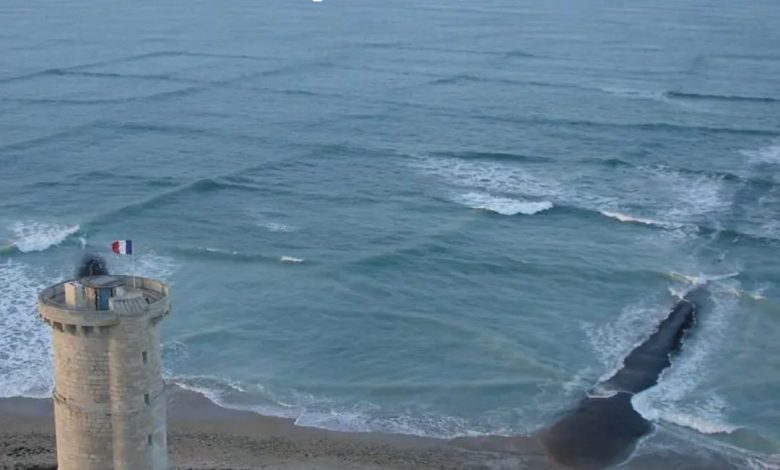
At first glance, it can look like a mesmerizing “checkerboard” drawn across the sea’s surface. But if you ever notice square-shaped wave grids forming in the ocean, treat it as an immediate warning sign: get out of the water as quickly and calmly as you can.
This rare-looking pattern is commonly linked to a hazardous sea state that can create confusing currents, powerful rip flow, and unpredictable wave behavior—conditions that can overwhelm even strong swimmers and create serious risks for small boats.
What are “square waves”?
So-called “square waves” are typically a visual sign of a cross sea (also called cross seas or a “squared sea”). Instead of waves traveling mostly in one dominant direction, the ocean surface shows two different wave systems crossing at an angle, creating a grid-like pattern that resembles a chessboard
Key idea: it’s not a special “shape” of a single wave—it’s two wave trains intersecting.
How do square waves form?
Square-wave grids can appear when:
- A wind-driven sea (waves created by local wind) moves one way
- A swell (longer waves generated by distant storms) moves another way
- Or two different swells meet from different directions
- The crossing angle is often described as greater than about 45 degrees in popular explanations
When these wave systems overlap, they interfere with each other and produce the distinct “watery grid” that people sometimes spot from cliffs, drones, or lighthouses.
Why square waves are dangerous
Square waves can be dangerous because they often come with water movement that is hard to predict and even harder to swim through.
What makes the water risky
- Conflicting wave directions can create chaotic surface motion and shifting channels of flow.
- Conditions associated with cross seas can produce strong, localized rip currents that pull people away from shore.
- For boats, a cross sea can cause unsteady rolling and difficult steering, especially for smaller vessels. Research and safety summaries frequently describe cross seas as a meaningful hazard for marine operations.
How big can these waves get?
Even when the grid looks “neat” from above, it can coincide with larger, more forceful waves. Popular safety summaries note that cross seas may generate waves up to around 10 feet (about 3 meters) in some conditions.
Where you might see them
Square-wave patterns have been reported in multiple coastal and open-ocean settings. A widely cited viewing location is Île de Ré (Isle of Ré), off France’s Atlantic coast, where the phenomenon is sometimes visible from elevated vantage points (like a lighthouse) rather than from the water itself.
Important: while some locations are famous for sightings, cross-sea conditions can occur in many regions when wave systems overlap.
What to do if you spot square waves
If you’re in the water and notice square-wave grids (or the sea suddenly feels “confused” and tugging in different directions), prioritize a safe exit.
If you are swimming or wading
- Get out of the water immediately—calmly, without rushing or panicking.
- Move toward shore at an angle that avoids fighting the strongest pull.
- If you feel yourself being pulled away from shore, treat it like a rip-current situation:
- Stay calm and conserve energy.
- Do not fight straight against the current.
- Swim parallel to the shoreline to escape the current’s grip.
- Once free, swim back toward shore at an angle, following breaking waves if possible.
- If you can’t make progress, float or tread water and signal for help (wave and call out).
Why “don’t fight it” matters: rip currents can move fast—measured speeds can reach up to about 8 feet per second, which is faster than an Olympic swimmer.
If you’re on a boat or paddlecraft
- Avoid entering areas where crossing waves are visible or where the surface looks like intersecting lines.
- If already caught in rough cross seas:
- Reduce speed, keep a stable heading, and prioritize control over progress.
- If conditions escalate, seek sheltered water and follow local maritime guidance.
How to reduce your risk before you ever get in
A major danger of ocean conditions is that they can look safe from the beach—even on sunny days.
Use these practical habits:
- Swim near a lifeguard whenever possible.
- Never swim alone.
- Check local surf and hazard forecasts before entering the water.
- If you spot unusual patterns—grid-like waves, strong sideways pull, or fast-moving foam/debris lines heading offshore—treat it as a warning and stay out.
Quick safety checklist
If you remember only one thing, remember this:
- Square-wave grids = crossing seas = elevated risk. Get out.
- If pulled by a current: stay calm, swim parallel, float and signal if needed.
- If unsure: don’t go out.