Small Objects, Big Impact: The Museum Case of Grenades and Caltrops
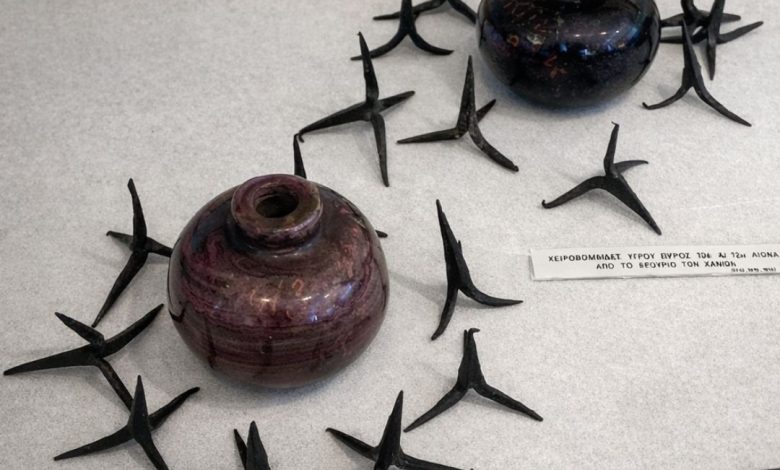
Byzantine “Liquid Fire” Grenades and Caltrops from the Fortress of Chania (10th–12th Century)
What You’re Looking At
The image shows a museum display of two key battlefield items dated to roughly the 10th to 12th century and associated with the fortress of Chania (Χανιά) in Crete. The objects are exhibited at the National Historical Museum in Athens, Greece.
- Ceramic “grenades”: round, bottle-like vessels believed to have been filled with liquid fire (Υγρό Πυρ)
- Caltrops: spiked iron obstacles scattered around the ceramics in the display
Ceramic Grenades: A Weapon Designed for Chaos
These small ceramic containers are often described as medieval “grenades” because they were intended to deliver an incendiary payload in a compact, throwable form. Their design reflects practical battlefield logic:
- Ceramic breaks easily, meaning impact could shatter the vessel and release its contents
- The rounded body is easy to hold and carry
- The small opening suggests the vessel could be filled and sealed for transport
In historical context, “liquid fire” (Υγρό Πυρ) is commonly associated with Byzantine-era incendiary warfare—valued less for precision and more for fear, disruption, and forcing enemies to retreat.
Caltrops: Simple Geometry, Serious Consequences
Caltrops were one of the most efficient “area denial” tools in pre-modern warfare. They are engineered so that no matter how they land, one sharp point remains facing upward. That single feature made them highly effective against:
- Horses, by injuring hooves and stopping charges
- Foot soldiers, by punishing movement through narrow paths or rushed advances
Why Caltrops Were So Effective
- They were quick to deploy: scattered in seconds
- They created instant slow zones: enemies had to stop, detour, or advance carefully
- They worked well near gates, roads, and chokepoints, especially around fortified locations
How These Two Items Worked Together in Defense
While each tool had a distinct role, together they represent a layered defensive strategy:
- Caltrops hinder movement and break formations
- The slowed or clustered enemy becomes more vulnerable to incendiary attacks, including liquid-fire containers
- The result is a battlefield environment shaped by control, delay, and panic, rather than direct hand-to-hand combat alone
Key Facts at a Glance
- Artifact types: ceramic incendiary containers and iron caltrops
- Associated site: fortress of Chania (Χανιά)
- Time period: 10th–12th century
- Displayed at: National Historical Museum, Athens, Greece
- Core purpose: defense and battlefield control (movement denial + disruptive incendiary force)
Why This Display Matters Today
This case is a reminder that historical warfare was not only about swords and armor. Small objects—carefully designed and strategically deployed—could shape entire encounters. The ceramic vessels represent the era’s attempts to weaponize incendiary materials, while caltrops show how engineering and geometry could be turned into a powerful tactical advantage.