Millionaire Builds Nearly 100 Homes to Reduce Homelessness in His Town.
Homelessness is a challenge nearly every city faces—large and small. While governments, nonprofits, and local organizations work to address it, the problem often feels stubbornly unsolved. In Fredericton, one entrepreneur decided to act directly, investing his own fortune to build housing, structure, and opportunity for people who needed a real second chance.
A $4 Million Personal Bet on a Better Solution
Marcel LeBrun, a millionaire who made his wealth after selling a successful business, committed roughly $4 million of his own money to build a tiny-home community designed specifically for people experiencing homelessness. His idea wasn’t just to provide shelter—it was to create a place where stability could actually stick.

The Project: 12 Neighbours
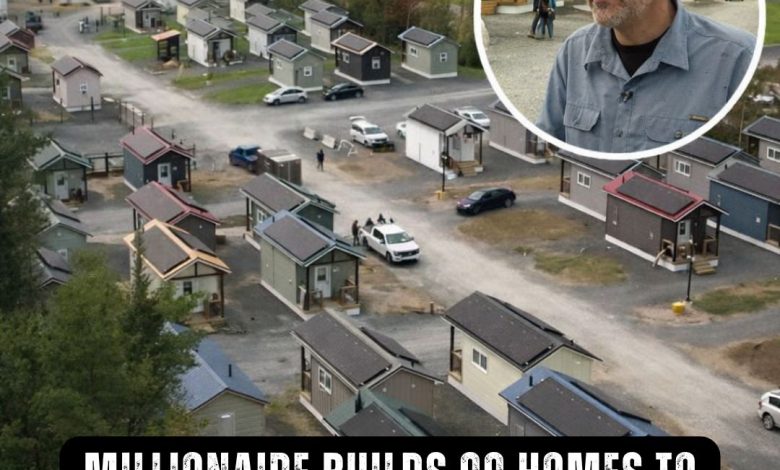
LeBrun’s plan centers on a gated community of 99 small homes plus an enterprise center where residents can work and earn income. The concept is built around more than housing: it’s about rebuilding daily routines, community support, and a sense of ownership—elements that can be difficult to regain after long periods without stable shelter.
Tiny Homes That Are Actually Livable
These aren’t bare-bones structures. The homes are fully furnished and include practical features people need to live with dignity: kitchens, living areas, bedrooms, full bathrooms, and solar panels on the roofs. The goal is to create a real home environment, not temporary “storage” for people.

How the Homes Get Built
To make the project scalable, LeBrun established a small factory-style operation where trained volunteers and workers assemble the units using efficient manufacturing methods. The build process is streamlined to produce a tiny home at a steady pace, after which the homes are transported and placed on foundations within the community.
Why Ownership Matters
A key part of LeBrun’s philosophy is that ownership changes behavior and outcomes. When someone has a space that is truly theirs, it can create a stronger sense of responsibility, personal control, and stability—especially for individuals who have spent years living in uncertainty.

Jobs as a Core Feature, Not an Afterthought
Housing alone isn’t the full solution. That’s why the enterprise center is central to the model. Within the community, residents can work in small businesses—including a coffee bar and a printing operation—creating pathways to income, work experience, and daily structure. It also encourages interaction between residents and the wider public, helping reduce social barriers instead of deepening them.
Criticism and the Debate Around “Separate” Communities
Projects like this often draw criticism. Some argue that concentrating formerly homeless individuals in one place risks isolating them from broader society and that reintegration should happen through dispersed housing across a city. LeBrun’s counterpoint is practical: building at a meaningful scale is often just as difficult as building small, so if a city wants measurable impact, it needs enough homes to actually move the needle.

Security and Resident Stability
LeBrun also emphasizes safety. People transitioning out of homelessness can face pressure from harmful connections or unstable relationships, especially when they finally gain a private space. To protect residents, the community includes gated access and surveillance measures intended to create a safer environment while people rebuild their lives.
A Community Inside a City
One of the long-term aims is to foster a healthier relationship between residents and the wider community—through services and local engagement that bring people together instead of keeping them apart. LeBrun frames the effort as “community building” in the broadest sense: not just helping individuals survive, but helping the city become more functional, more humane, and more resilient.

The Takeaway
What LeBrun has built in New Brunswick is more than a headline-grabbing charity project. It’s a structured attempt to combine housing, security, ownership, and employment into a single model—designed to help people move from survival to stability. Whether every city could replicate it is an open question, but the effort shows what can happen when someone treats homelessness as a solvable design problem—and commits real resources to testing a solution.