How many eggs do I have left?
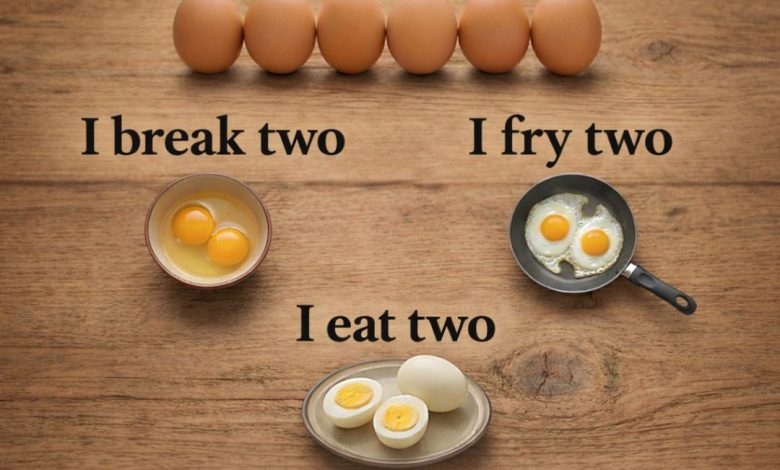
A simple image has been making the rounds online because it looks like a basic subtraction problem, but it’s really a word-and-logic trap.
The riddle says:
- “I have six eggs.”
- “I break two.”
- “I fry two.”
- “I eat two.”
- “How many eggs are left?”
What Most People Assume
Many readers quickly do this math: 6 − 2 − 2 − 2 = 0.
But that assumes the “two” eggs are different eggs each time, which the sentence never actually says.
The Key Detail People Miss
You can’t fry eggs unless they’ve been cracked first. That means the two eggs you fry can be the same two eggs you already broke.
So the sequence can be understood like this:
- You start with 6 eggs.
- You break 2 eggs (those 2 are now cracked).
- You fry those same 2 eggs.
- You eat those same 2 eggs.
You only used two eggs total for all three actions.
The Correct Answer
After using 2 eggs, you still have 4 unbroken eggs left.
Correct answer: 4 eggs are left.
Why This Puzzle Works So Well
This riddle goes viral because our brains want to treat each “two” as a brand-new pair. But the wording allows the actions to overlap, and once you notice that, the result becomes obvious.
The “break two,” “fry two,” and “eat two” can refer to the same two eggs.