What is that strange toothed part on kitchen scissors for?
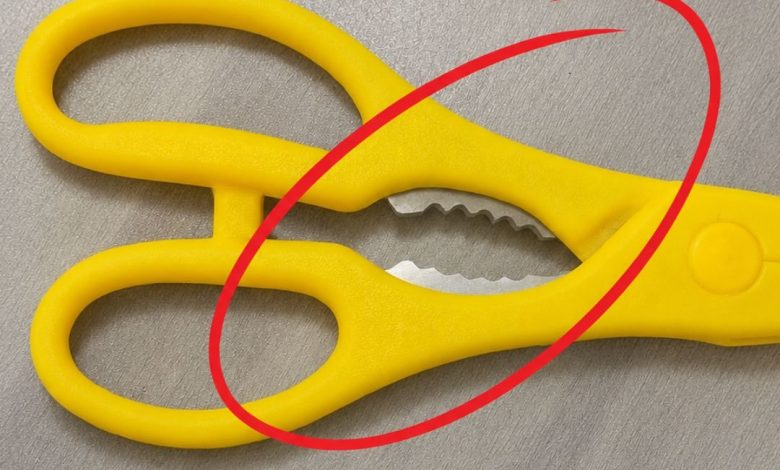
Many kitchen scissors have a small, jagged opening between the handles near the pivot. Because it does not resemble a cutting blade, some people assume it is decorative or left over from manufacturing.
It is usually neither. On many multipurpose kitchen shears, that serrated section is a built-in gripping tool designed to hold small, hard or slippery objects.
What Is the Toothed Section Called?
Manufacturers do not use one universal name for it. Depending on the design and intended use, it may be labeled a:
- Grip notch
- Jar or bottle-cap opener
- Nutcracker
- Bone gripper
- Serrated gripper
The important point is that its purpose varies by model. A notch designed for bottle caps may not be strong enough for bones, while heavy-duty poultry shears may include a reinforced section specifically intended for tougher food preparation.
How Does It Work?
The two sets of ridges come together as the handles are squeezed. These interlocking teeth create friction and traction, helping prevent a round or slippery object from moving.
Because the notch sits close to the scissors’ pivot, the handles also provide mechanical leverage. That can make certain tasks easier than attempting them with bare hands.
In practical terms, the feature can turn one utensil into a cutter, gripper and light-duty cracker.
Common Uses for the Serrated Notch
1. Loosening Small Bottle Caps and Jar Lids
The notch can help grip certain smooth plastic or metal caps.
Place the cap securely between the ridges, hold the container steady and apply gentle turning pressure. This works best on small caps and lids that fit comfortably inside the opening.
It is not an ideal tool for large jars. If the lid does not fit securely, forcing it may cause the scissors to slip.
2. Cracking Nuts
Some kitchen shears are designed to crack walnuts, pecans or hazelnuts.
Place the nut inside the notch and squeeze with slow, even pressure. Rotating the nut and cracking it from more than one angle may help preserve the kernel instead of crushing everything inside.
Only use this method when the manufacturer identifies the feature as a nutcracker.
3. Gripping Seafood Shells
A serrated notch may help fracture crab legs, lobster shells or other relatively thin shells.
Use light pressure and avoid crushing the shell directly into the meat. For large claws or especially hard shells, a dedicated seafood cracker is safer and more effective.
4. Holding Slippery Food or Packaging
The ridged area can sometimes stabilize a slippery edge while the blades perform the actual cutting. This may be helpful with vacuum-sealed food bags or tough plastic food packaging.
However, the notch itself is generally a gripper rather than an additional cutting blade.
5. Handling Poultry—But Only With the Right Shears
Some heavy-duty poultry shears include a reinforced toothed section for gripping joints or small bones. That does not mean every pair of kitchen scissors is suitable for breaking bones.
Lightweight shears may bend, loosen at the pivot or slip under excessive force. For poultry preparation, use shears specifically rated for that job and follow the manufacturer’s instructions.
Important Safety Rules
Use the notch only for tasks the scissors were designed to handle. Do not assume that every serrated opening has the same purpose.
Keep fingers away from the gap while squeezing, and stop immediately if the handles twist, the pivot feels loose or the object begins to slip.
Avoid using kitchen shears on electrical wire, metal, paint cans, coconut shells, thick bones or other non-food materials. These tasks can damage the blades and create an injury risk.
After handling raw meat, seafood or nuts, wash the serrated grooves carefully. Small food particles can become trapped between the teeth.
How to Tell Whether Your Scissors Include This Feature
Look near the pivot for two opposing rows of ridges that align as the handles close. The opening may be narrow and curved for nuts, more rounded for caps, or heavily reinforced on poultry shears.
The most reliable way to identify its intended function is to check the product packaging, manufacturer’s website or instruction manual. Appearance alone is not always enough.
Why Manufacturers Add It
The feature makes efficient use of an area of the scissors that would otherwise serve only as part of the handle. It can reduce the need for separate bottle grippers, nutcrackers or other small utensils.
For users with limited hand strength, the added traction and leverage may also make certain light-duty tasks easier. However, it should not be treated as a substitute for a properly designed accessibility tool when substantial force is required.
The Bottom Line
The toothed notch on many kitchen scissors is a functional gripping surface—not a defect. Depending on the model, it may help loosen small caps, crack nuts, grip seafood shells or handle tougher food-preparation tasks.
The key is to use it carefully and recognize its limits. A clever multipurpose feature is useful only when the scissors are strong enough—and specifically designed—for the job.