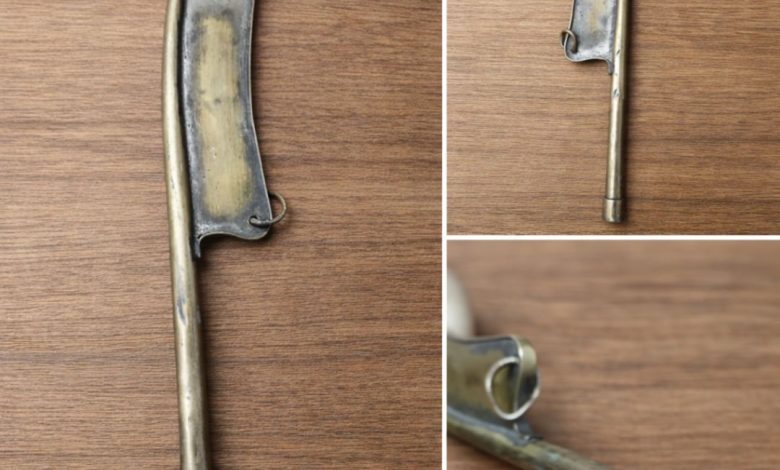
This dull bladed brass piece with hollow handle and “balls” on top. What is this thing?
1) What It Is (Name)
This object is a boatswain’s call (also commonly called a bosun’s whistle). It is a compact, purpose-built whistle used on boats and ships to produce a sharp, high-pitched sound that can be heard above wind, waves, and engine noise.
2) Key Identification Details (From the Item)
- Material: Sterling silver
- Maker/Marking: A.E. Co., Utica, NY
- Length: 5 1/2 in. (14 cm)
- Weight: 0.8 oz
- Type: Boatswain’s call (nautical signaling whistle)
3) When It Originated (Historical Background)
The boatswain’s call traces back to the era of sailing ships, when crews needed a reliable way to transmit orders across a noisy deck. While the exact inventor is not tied to one single person, the design became widely adopted in traditional naval practice and remained in use because it was fast, loud, and unmistakable.
- Practical origin: Age of sail / early naval traditions (used long before electronic communication)
- Why it lasted: It delivers clear signals instantly, even in harsh sea conditions.
4) Who Created This Example (Maker)
This specific whistle was manufactured by A.E. Co. of Utica, New York. The provided details do not state an exact production year for this individual piece, but it follows the established, recognizable boatswain’s call form used over generations.
5) What It Was Used For (Purpose and Function)
A boatswain’s call was used to communicate commands and routine ship signals, such as:
- Calling the crew’s attention (a signal that something is about to be announced or done)
- Directing sailors during work (coordinating tasks quickly across the deck)
- Ceremonial and formal signals (naval traditions, honors, and structured routines)
- Emergency or priority communication when shouting would be ineffective
6) How It Works (Simple Explanation)
The whistle’s shape is engineered to create a piercing, controlled tone. By changing:
- breath pressure,
- finger position, and
- how the sound chamber is partially covered,
a trained user can produce different signal patterns that sailors recognize.
7) Visible Features in the Photo (What You’re Seeing)
- A tapered tube (the “gun”) where airflow travels to form the tone
- A rounded end piece often called the buoy, part of the sound-producing chamber
- A small lanyard ring (seen on the side), used to attach a cord so it can be worn and not dropped overboard
- A curved body plate that helps shape how the whistle is held and controlled
8) Quick Takeaway
Even though it is small and lightweight, the boatswain’s call served a big role: clear, immediate communication at sea. This sterling silver example by A.E. Co., Utica, NY reflects both practical maritime engineering and the long-standing traditions of shipboard life.