Second-Most Powerful Cosmic Ray Ever Recorded Sparks New Questions About the Universe
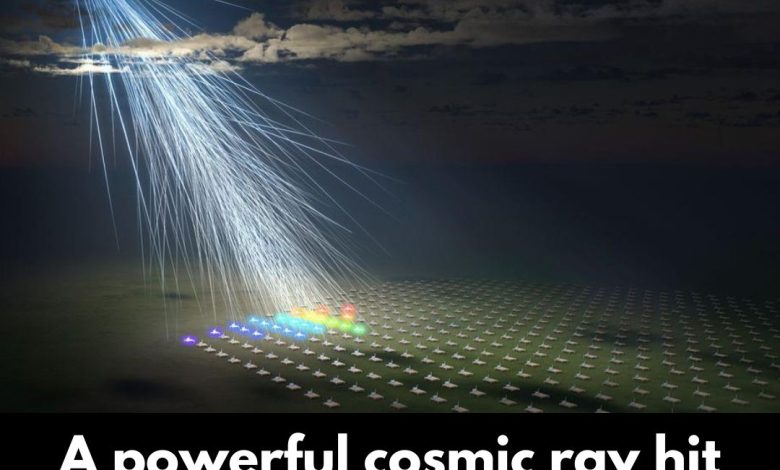
What happened
In May 2021, an ultra-high-energy cosmic ray later nicknamed “Amaterasu” struck Earth’s atmosphere with an estimated energy of 240 quintillion electron volts.
Where it was detected
- Detector: Telescope Array
- Location: Utah, USA
- The event created a massive shower of secondary particles as it collided with air molecules high above Earth.
Why this is a big deal
- Ranking: The second-most powerful cosmic ray ever recorded
- Only stronger example: the 1991 “Oh-My-God” particle
- Energy comparison: its energy was millions of times greater than what leading human-built accelerators (including the Large Hadron Collider) can produce.
What makes it mysterious
Normally, cosmic rays this energetic are expected to travel in nearly straight lines, which should help scientists trace them back to where they came from.
But when researchers reconstructed the incoming direction, they found something unexpected:
- Instead of pointing toward a likely powerhouse (such as a supernova, active galaxy, or black hole region), the trajectory led to a large cosmic void
- A cosmic void is a region of space with far fewer galaxies and less matter than average—an unlikely place to generate such an extreme particle.
What scientists think this could mean
Because the “Amaterasu” direction doesn’t match the usual suspects, it raises possibilities such as:
- An undiscovered type of cosmic accelerator hidden near or beyond the void
- Magnetic field effects that may have bent the particle’s path more than expected
- Something more speculative, including unknown cosmic phenomena or even unusual structures/defects in spacetime that current physics doesn’t fully explain.
What happens next
Researchers will likely focus on:
- Collecting more ultra-high-energy events to see whether this “void direction” repeats
- Improving models of cosmic magnetic fields that can distort particle trajectories
- Searching for faint or unconventional sources that standard surveys might miss.
Bottom line
“Amaterasu” is not just a record-setting cosmic particle—it is a clue that the universe may still be hiding powerful mechanisms we don’t yet understand, especially when the best “map back” points to what looks like empty space.
Source: Telescope Array Collaboration. Observation of an ultra-high-energy cosmic ray with a large zenith angle by the Telescope Array experiment. Science.