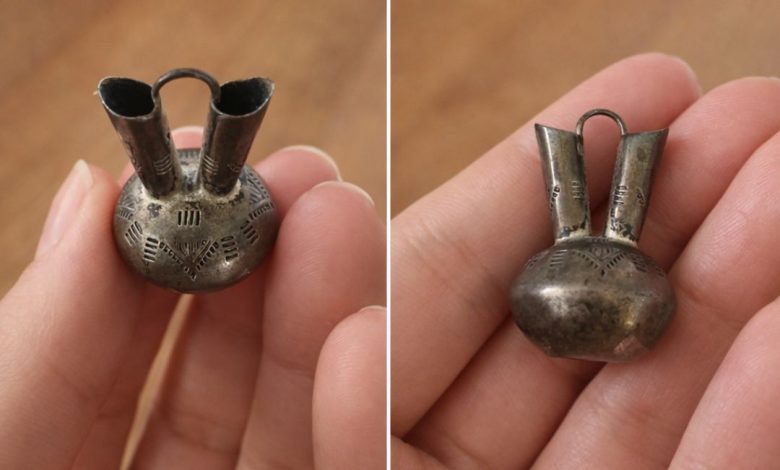
I was given this small silver object as a pre-wedding gift with no explanation. It has small lines engraved on it.
1) Name and What You’re Looking At
- Common names used by collectors:
- Native American “Wedding Vase” Pendant
- Handmade Wedding Pot / Wedding Vase Jewelry Pendant
- Miniature Twin-Spout Vase Pendant
- Based on the photos, the piece is a small metal pendant shaped like a traditional “wedding vase”:
- Two upright spouts (the twin tubes)
- A small loop/handle-like arch connecting the spouts at the top
- A rounded vessel body with stamped/engraved geometric decoration
- The listing text also references: “E.M.W.”, “Handmade”, “Wedding Pot”, and “VASE NATIVE.”
2) Estimated Time Period (When It Likely Dates From)
Because the exact hallmarking and full back details are not shown, the safest identification is an estimate:
- Most jewelry pieces like this—mini wedding vases rendered as pendants—are commonly seen as vintage Native American–style or Native-made silverwork from the mid-to-late 20th century, especially:
- 1970s–1990s (most typical range for this style showing up in the vintage market)
- Why that timeframe is plausible:
- The form matches a widely produced Southwestern jewelry motif popular in that era.
- The construction and decorative stamping are consistent with handcrafted tourist-market and collector-market silverwork from the late 1900s.
3) Who Made It (Maker/Creator)
- The text “E.M.W.” is most likely:
- A maker’s initials (artisan mark), OR
- A seller-attributed maker ID used in a listing
- What can be stated carefully and accurately:
- It was handmade (as described), likely by a Native American silversmith or produced in a Southwestern Native style.
- Important note for attribution:
- To confirm a specific person or tribe, you typically need:
- A clear hallmark photo (letters/symbols on the reverse)
- Any “STERLING,” “925,” or tribal/artist marks
- Provenance (tag, receipt, or documented artist listing)
- To confirm a specific person or tribe, you typically need:
4) What It Was Used For (Purpose and Function)
This object is primarily jewelry, but its shape references a meaningful cultural vessel form.
Practical function (today):
- Worn as a pendant/charm on a chain or cord
- Used as:
- Adornment
- Collectible Southwestern/Native-inspired jewelry
- Gift piece symbolizing partnership or unity
Symbolic function (the design it represents):
- The “wedding vase” motif is associated with Southwestern Native pottery traditions, especially the well-known Hopi-style wedding vase form (widely recognized and reproduced as an art motif).
- Commonly described symbolism of the twin-spout form:
- Two lives joined together (two spouts)
- Shared path/union (the bridging handle)
- Harmony, balance, partnership (the paired structure)
5) Key Visual Details From the Photos
- Twin spouts: distinctive, flared openings
- Top bridge: a small arched loop connecting the two spouts
- Rounded body: compact, bulb-like vessel base
- Decorative stamping: geometric, radiating, and banded patterns typical of Southwestern-inspired metalwork
- Aged patina: visible darkening and wear consistent with a vintage piece
6) How to Verify Authenticity and Value (Quick Checklist)
If you want to document it accurately for selling or collecting, check the back/underside for:
- Metal mark: STERLING, 925, COIN, or similar
- Maker hallmark: letters/symbols that could match E.M.W.
- Construction: solder seams, hand-stamped marks, hand-finished edges
- Weight and feel: sterling typically has a heavier, denser feel than base metal
In Summary
- This is best described as a vintage Native American–style (or Native-made) handmade “wedding vase” pendant, associated with Southwestern symbolism of union and partnership.
- The most reasonable era estimate is late 20th century (often 1970s–1990s) unless hallmarks prove otherwise.
- E.M.W. likely indicates an artisan’s initials or a listing-based maker reference, but a hallmark photo is needed to confirm the individual maker.