Have You Ever Seen One Of These?
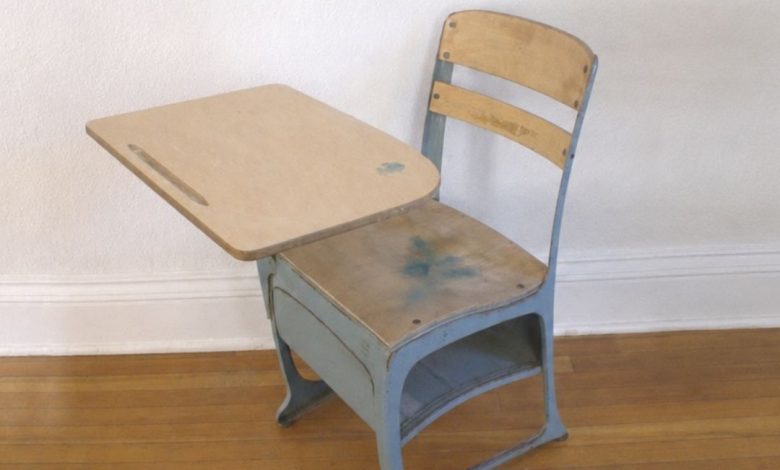
The object in the photo is a vintage school desk with an attached chair, often called a schoolhouse desk, student desk-chair combo, or chair desk. For many Americans, this simple wooden-and-metal seat brings back memories of old classrooms, chalkboards, spelling tests, and carefully sharpened pencils.
This type of desk was commonly used in American schools during the early to mid-20th century, especially from around the 1920s through the 1960s. Similar school desks existed even earlier, but the version with a wooden writing surface, wooden seat, and metal frame became especially common in classrooms across the United States.
One interesting detail is the top of the desk. Many of these desks had a pencil groove to keep pencils from rolling away. Some also had a small round opening or metal insert that was originally used for an inkwell, back when students wrote with dip pens before ballpoint pens became common.
The attached chair and writing surface made the desk practical for crowded classrooms. Students could sit, read, write, and store books all in one compact space. Many models also included a small storage shelf under the seat or desk, where children kept textbooks, notebooks, lunch boxes, or school supplies.
Its main purpose was simple: to give each student a personal place to study and write. The attached design saved space, kept classrooms orderly, and made it easier for teachers to arrange rows of students facing the front of the room.
These desks were built to last. The metal frame made them sturdy, while the wooden seat and writing surface could be repaired or refinished. That is why many of them still survive today in antique shops, old schools, museums, and private homes.
Today, vintage school desks are often collected as nostalgic pieces of Americana. Some people use them as decorations, plant stands, children’s writing desks, or display pieces in country-style homes. Others keep them simply because they remind them of a different era in American education.
The desk in the photo appears to be a mid-century school desk-chair combination, likely from the 1940s to 1960s, though the exact maker and year cannot be confirmed from the image alone. Companies such as American Seating Company, Heywood-Wakefield, and other school furniture manufacturers produced similar classroom desks during that period.
For anyone who grew up before modern plastic classroom furniture became common, this desk is more than just an old chair. It is a small piece of school history. It represents a time when classrooms were simpler, desks were heavier, and students learned their lessons from blackboards, paper books, and handwritten notes.