Found this machine sealed in between the walls of the house.
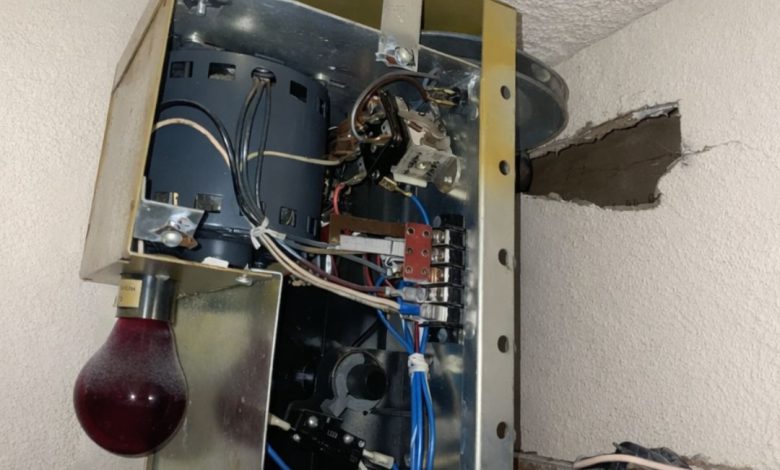
While clearing out the attic, I noticed something odd tucked behind the drywall—part fan motor, part electrical panel. It was covered in dust, packed with old wiring, and completely silent after years out of sight. One detail stood out immediately: a red bulb labeled “MEDIUM.” Nearby was a belt-driven assembly and a chunky, industrial-looking motor housing.
After comparing it with several old YouTube videos, the identity clicked: it was a Montgomery Ward garage door opener—a screw-drive model, likely from the late 1970s to early 1980s.

A Suburban Garage Staple
Montgomery Ward built garage door openers that were heavy-duty, rugged, and made to last. This one used a screw-drive mechanism, meaning the door moved up and down along a long threaded rod rather than a chain.
Compared with chain-drive openers, screw drives were often smoother and quieter, but they came with a very specific personality: a mechanical buzz and whine that many people still associate with older garage systems. That sound wasn’t a flaw—it was part of the era.
And this was a different era:
- No photo-eye safety sensors
- No rolling-code remotes
- No smart home integration
These machines were built to be physical, straightforward, and durable.

Built Like They Used To Build Things
Everything about the unit felt like a snapshot from a time when appliances were designed to be serviced instead of replaced.
The red “MEDIUM” bulb was most likely part of the opener’s courtesy lighting system, turning on when the door activated. The motor enclosure was all metal—no thin plastic shells, no hidden boards—just real switches, heavy-gauge wiring, and steel brackets.
Even the terminal block reflected that old-school approach: exposed screws, clearly routed wires, and a layout that was meant to be understood. It was the kind of setup where you could look at it and immediately tell what connected where.
Why Was It Hidden Behind a Wall?
The most likely explanation is simple: the opener stopped being useful, and instead of removing it, someone chose the easier route—build around it. Another possibility is that the garage layout changed over time, leaving the opener in a spot where it no longer fit the new setup.
Either way, it sat sealed away behind drywall like a forgotten machine in a time capsule—until now. Finding a Montgomery Ward screw-drive opener in that condition felt less like discovering junk and more like uncovering a small piece of everyday American history.
A Sound That Meant Something
Back then, the sound of a garage door opener wasn’t just background noise. It was a signal. The hum of the motor and the clunk of the mechanism told everyone in the house: someone’s leaving or someone’s home.
That’s what made these old openers memorable—their presence. The Montgomery Ward screw drive wasn’t subtle. It was loud, distinctive, and dependable, and for many households it became part of the rhythm of daily life.
The unit I found is no longer functional. But even now, sitting behind a wall, it still feels like it’s “on duty” in its own way—quietly preserving a little slice of the classic American garage era.