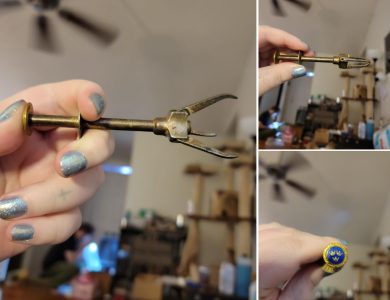
Any idea what this is? It’s my Dad’s… Could be for golf, could be for cigars.
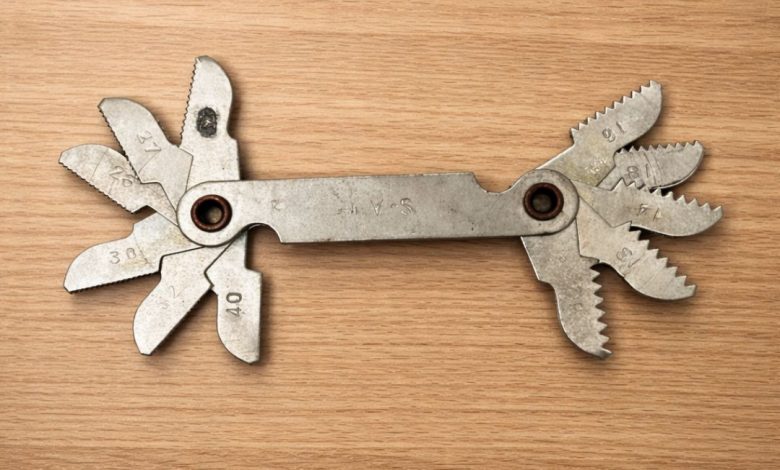
The Tool’s Name
- Common name: Thread gauge / Screw pitch gauge
- More specific: Standard (inch) thread pitch gauge measured in Threads Per Inch (TPI)
- What the photo shows: A folding, leaf-blade thread pitch gauge with multiple serrated blades marked with TPI numbers (for example 16, 18, 20, 22, etc.), used to match the profile of a screw or bolt thread.
What a Thread Pitch Gauge Does
A thread pitch gauge is a simple measuring tool that lets you identify a screw thread size by matching the thread’s spacing to one of the gauge’s toothed blades.
Primary uses
- Confirming thread pitch on bolts, screws, studs, and threaded rods
- Sorting mixed fasteners (especially in repair shops, maintenance rooms, and toolboxes)
- Verifying compatibility before cutting threads, tapping holes, or ordering replacements
- Checking worn or damaged threads by comparing them against a known pitch blade
Why It Matters
Even if two fasteners look similar, a small difference in pitch can cause:
- Cross-threading
- Stripped threads
- Loose assemblies
- Failed repairs or unsafe installations
When It First Appeared (Historical Timing)
Thread pitch gauges became practical and widely used once screw threads began to be standardized across industries.
- Early roots: Precision thread measurement tools appear alongside industrial machining in the mid-1800s
- Wider adoption: As national and industrial thread standards spread, leaf-style pitch gauges became common shop tools in the late 1800s into the early 1900s
- Modern era: Mass production and global trade made thread gauges a standard fixture in mechanical work through the 20th century and beyond
Who Created It (Key People Behind Thread Standardization)
No single inventor owns the thread pitch gauge in the way a patented gadget might. Instead, it emerged from the need to support standardized screw threads—driven by influential engineers who defined thread systems:
- Sir Joseph Whitworth (UK): Helped establish one of the first widely adopted standard screw thread systems in the 19th century, pushing industry toward consistent pitches and forms
- William Sellers (US): Promoted a standardized American thread form that supported interchangeability in manufacturing
These standardization movements are what made practical shop tools like the thread pitch gauge essential and widely produced.
How It Works (Simple Step-by-Step)
- Open the gauge and select a blade with a likely number (e.g., 18 TPI).
- Press the blade teeth gently into the screw threads.
- If the teeth sit perfectly in the grooves with no gaps and no rocking, that pitch matches.
- If it doesn’t fit cleanly, try the next higher or lower TPI blade.
- Once matched, record the result: “This fastener is 18 TPI.”
Key Details to Look For on the Tool
- Blade numbers: These are the thread pitches (often TPI for inch standards).
- Tooth shape: Some gauges include different profiles for different thread forms.
- Sets for “international” use: Many gauges include multiple systems, commonly:
- Inch/Imperial (TPI)
- Metric pitch (mm) on other models or combination sets
Where You’ll Commonly See Thread Pitch Gauges Used
- Automotive repair
- Machining and metalworking
- Maintenance and facilities work
- Bicycle and motorcycle servicing
- Plumbing and fittings (thread verification before sealing/assembly)
A Quick Practical Note
A pitch gauge tells you the spacing/pitch, not the full specification. To fully identify a fastener, you typically also confirm:
- Major diameter (with calipers)
- Thread standard/form (depending on region and application)
In Summary
The thread pitch gauge is a compact, durable tool designed to solve a constant workshop problem: “What thread is this?” Born from the industrial push toward standardized screws in the 19th century, it remains one of the fastest and most reliable ways to identify thread pitch—especially when you’re dealing with real-world parts that have wear, grime, or unknown origin.